
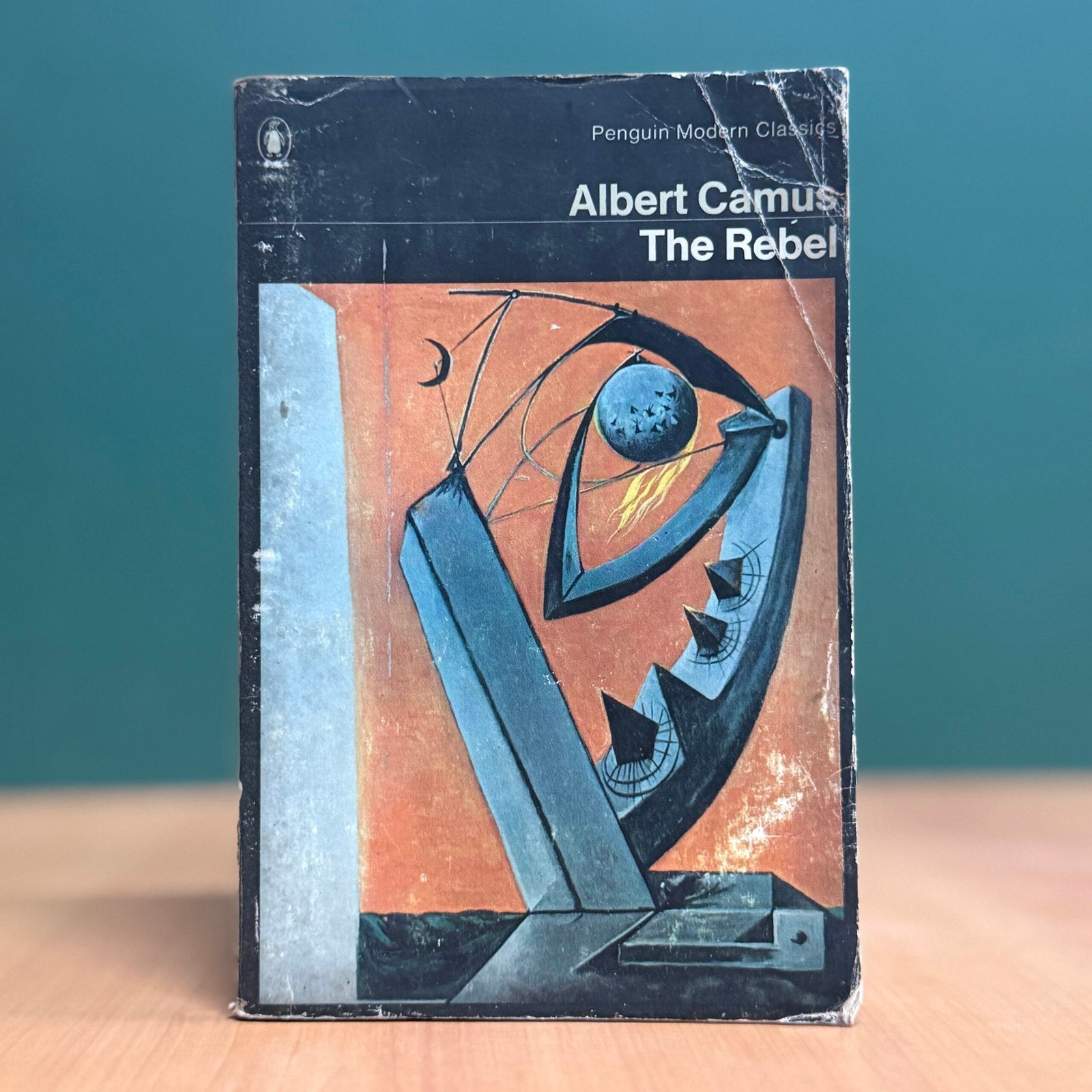

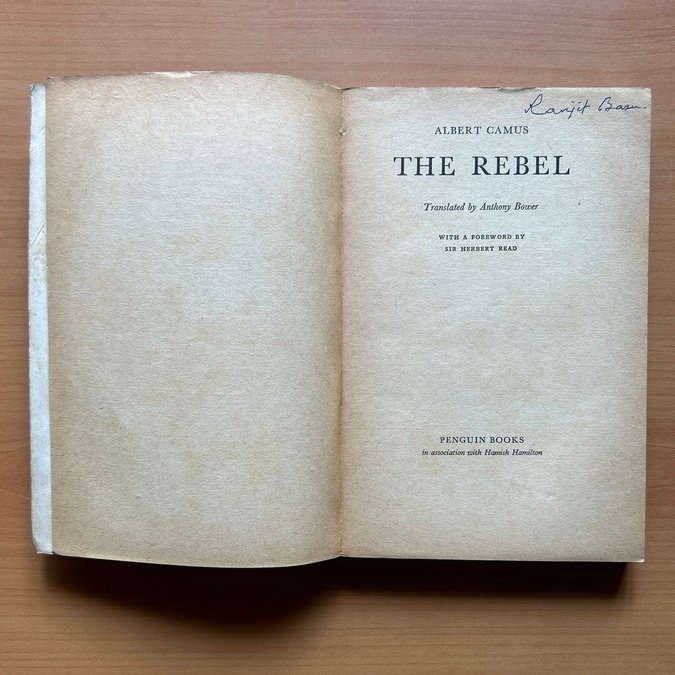
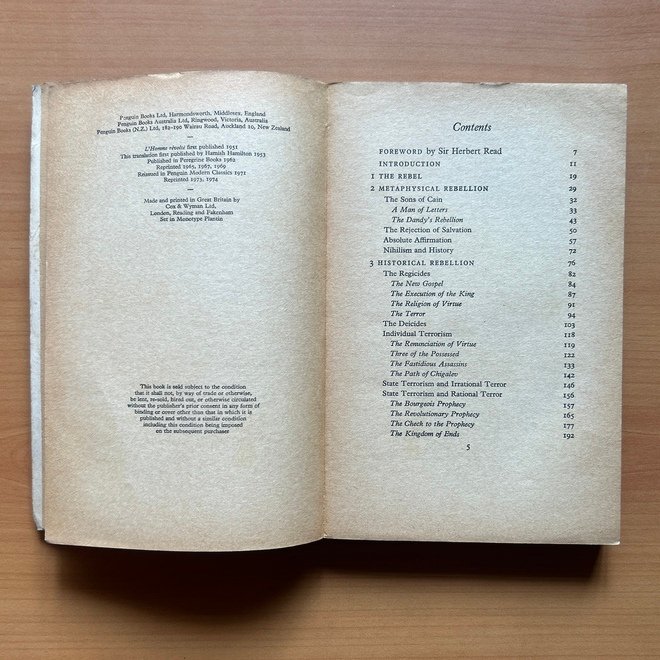
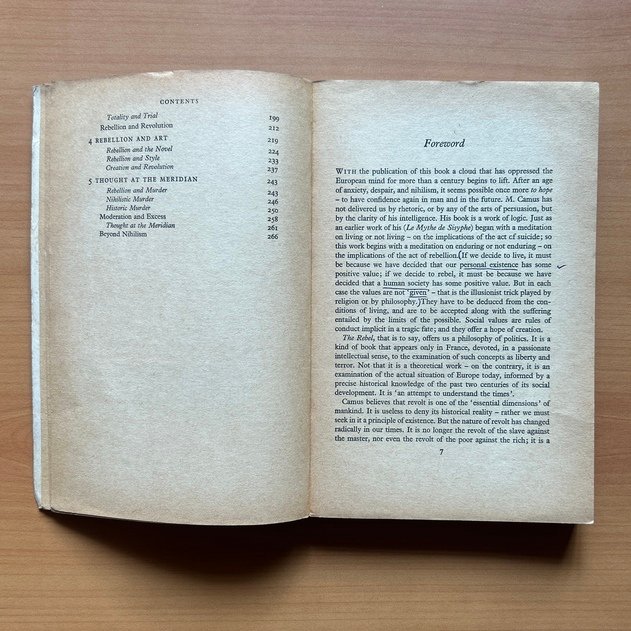
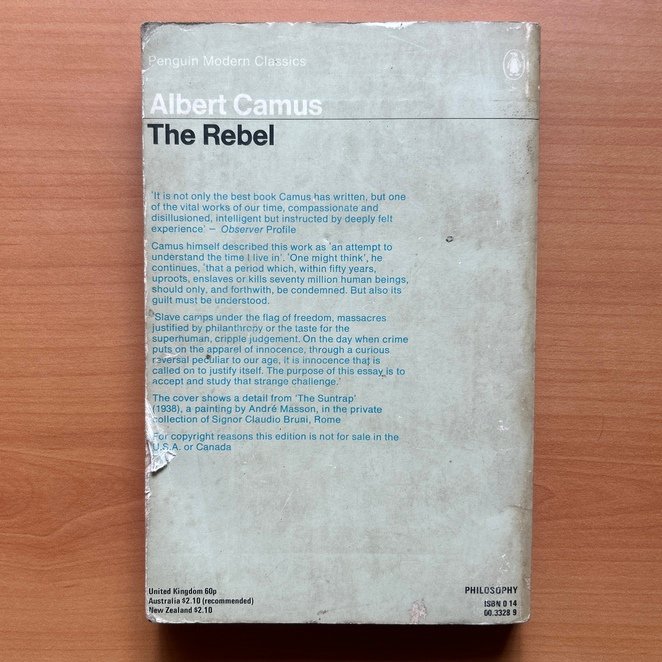
The Rebel
Author: Albert Camus
Publisher: Penguin Books
Edition: 1974
Binding: Paperback
Pages: 270
Size: 4.5 × 0.5 × 7 inches
Language: English
The Rebel is one of Albert Camus’s major philosophical works and an important contribution to twentieth-century discussions of morality, political violence, freedom, and revolution. Originally published in French as L’Homme révolté in 1951, the work investigates the philosophical foundations and consequences of rebellion.
Camus begins with a fundamental question: what does it mean for a person to say “no” to an existing condition? For Camus, rebellion can arise when an individual encounters injustice or an unacceptable limitation and asserts that there are values that should not be violated. Rebellion therefore contains both an element of resistance and an implicit claim concerning human dignity.
The book distinguishes between forms of rebellion and the historical development of revolutionary ideas. Camus considers how an initial demand for freedom or justice can become transformed when political movements attempt to establish absolute systems based on ideological certainty. This leads him to examine the relationship between rebellion, revolution, violence, and political power.
Camus also engages with a broad range of philosophical and historical traditions. His discussion moves through ideas associated with nihilism, revolutionary politics, Marxism, anarchism, and other currents of modern European thought. Rather than treating rebellion simply as a political strategy, he examines its underlying philosophical assumptions and moral consequences.
A central concern throughout the work is the problem of limits. Camus argues that rebellion contains an implicit recognition that certain limits should not be crossed. When an ideology claims unlimited authority in the name of an imagined future, Camus considers the possibility that the pursuit of liberation may instead produce new forms of domination.
The work is closely connected to themes found elsewhere in Camus’s writing, including absurdity, human dignity, freedom, responsibility, and moral choice. However, The Rebel extends these questions into the areas of political philosophy and history, making it particularly significant for readers interested in the relationship between philosophical ideas and political action.
This 1974 Penguin Books paperback edition contains 270 pages and measures approximately 4.5 × 0.5 × 7 inches. Its compact vintage format makes it suitable for readers and collectors interested in Albert Camus, existentialist and absurdist thought, political philosophy, ethics, and twentieth-century intellectual history.
- Title: The Rebel
- Author: Albert Camus
- Publisher: Penguin Books
- Edition: 1974
- Binding: Paperback
- Pages: 270
- Size: 4.5 × 0.5 × 7 inches
- Language: English
- Primary Subject: Philosophy
- Key Topics: Rebellion, revolution, freedom, justice, violence, ethics, nihilism, political philosophy
- Literary Context: Twentieth-century European philosophy
- Ideal for: Philosophy students, readers of Camus, political-philosophy enthusiasts, intellectual-history researchers, and collectors of vintage Penguin Books
🔹 Collector’s Note
This 1974 Penguin Books paperback edition of The Rebel is a significant vintage philosophical volume by one of the major intellectual figures of twentieth-century Europe. Its exploration of rebellion, political violence, freedom, justice, and moral responsibility makes it particularly relevant to collections devoted to philosophy and political thought. The 270-page Penguin format also makes it an appealing addition to collections of Camus, existentialist literature, modern philosophy, and vintage Penguin paperbacks.


Reviews
There are no reviews yet.